Drawing a City from Above (Bird's-Eye View)
From above, a city is a grid of streets plus boxes of different heights. The streets converge to two points on a horizon high above the frame, and every building's vertical edges lean toward a third point below.
In short
- Horizon high, often above the page.
- Lay the street grid first, then extrude buildings down toward the third point.
- Taller buildings lean more at the edges of the picture.
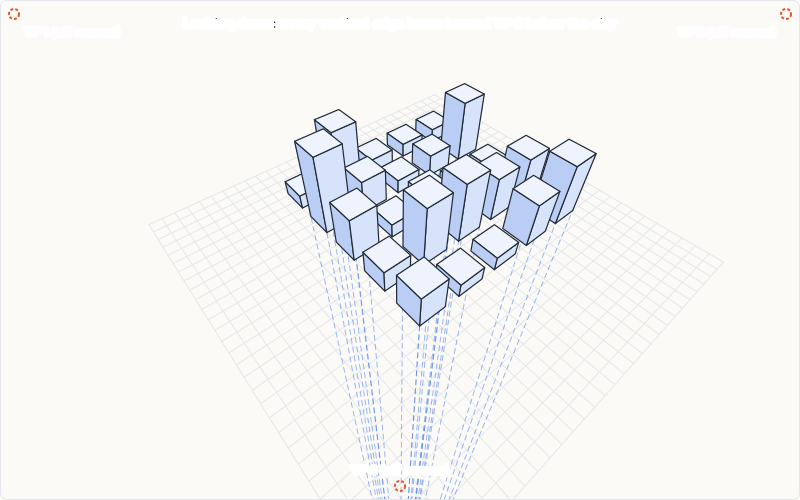
Steps
- Place the horizon high. It may be above the page; mark the two vanishing points on it or on tape outside the page.
- Place the third point below. Far below the centre of the page.
- Draw the street grid. Two families of lines to the two horizon points.
- Raise the buildings. From each block's footprint, edges run toward (or away from) the third point; close the roofs with lines to the horizon points.
- Detail and shade. Add roof details, windows on visible faces and cast shadows on the streets.
Tips
- Draw roofs first, then drop edges to the ground: it is easier to see what is hidden.
- Vary heights for rhythm, and keep the tallest buildings away from the picture edges to avoid distortion.
- Atmospheric perspective helps: lighter, less detailed blocks in the distance.
Frequently asked questions
Can I draw a bird's-eye view in two-point perspective?
Only if you look straight ahead from a high place. Once you tilt down, verticals converge and you need the third point.