Three-Point Perspective Explained
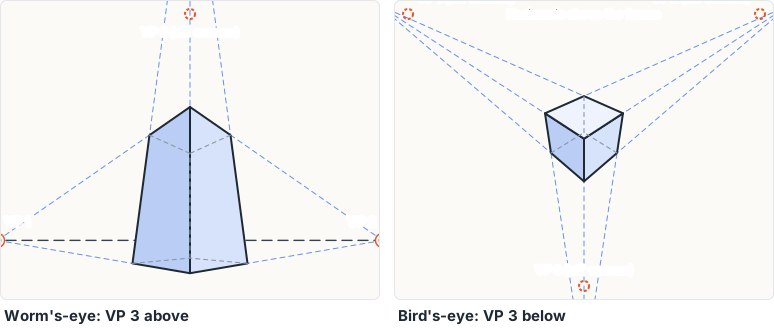
Three-point perspective is two-point perspective with a tilted view. When you look up, vertical edges converge to a third vanishing point above; when you look down, to one below.
In short
- Use it for strong upward or downward views.
- Two vanishing points on the horizon, one far above or below.
- Looking up: horizon is low. Looking down: horizon is high, often off the page.
- Keep the third point far away unless you want an extreme look.
Steps
- Decide up or down. Looking up puts the horizon low and the third vanishing point above. Looking down does the opposite.
- Place the two horizon points. Wide apart, as in two-point perspective.
- Place the third point. Far above or below the centre of the page — farther is calmer.
- Draw the nearest vertical edge. It points toward the third vanishing point, not straight up.
- Build the box. Horizontals go to the two horizon points; every 'vertical' goes to the third point.
The vanishing point triangle
The three vanishing points form a triangle. Objects drawn near the middle of that triangle look natural; objects near its edges distort quickly. If something looks stretched, move all three points farther apart.
When to use it
- Skyscrapers and towers from the street
- Cities and interiors from above
- Dramatic character shots — a hero towering over the camera, or a figure seen from a balcony
Frequently asked questions
Is three-point perspective just tilted two-point?
Yes, geometrically. Tilting the view makes vertical lines converge, which adds the third point.
Where is the horizon in a bird's-eye view?
High, and often above the top of the picture.