Five-Point Fisheye Perspective
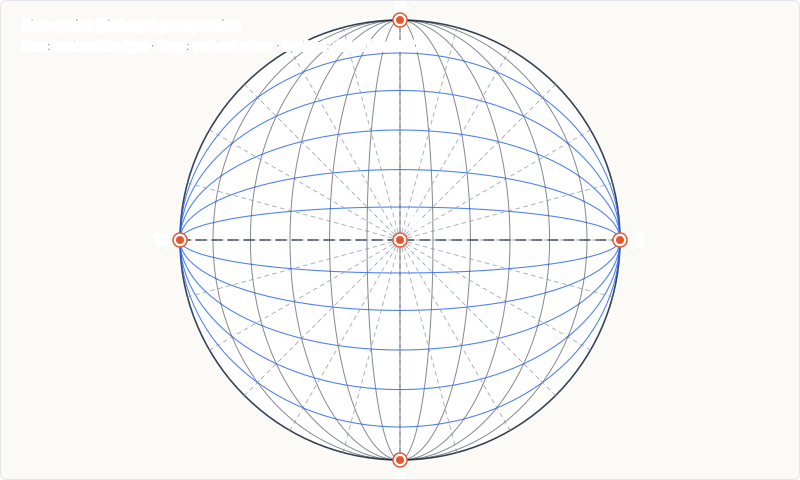
Five-point perspective is the drawing version of a fisheye lens. Four vanishing points sit on a circle — north, south, east and west — with a fifth in the centre, and straight edges bend into arcs between opposite points.
In short
- Four points on a circle (N, S, E, W) and one in the centre.
- Edges parallel to the picture plane become ellipse arcs between opposite points.
- Edges pointing straight away from you stay straight and run to the centre.
- The whole scene fits inside the circle.
The geometry in plain words
Imagine projecting the world onto a sphere around your eye and then flattening that sphere into a disc. A straight line in the world becomes a great circle on the sphere, which flattens into an ellipse whose long axis is a diameter of the disc. That is why every curve in the grid passes through two opposite points on the rim.
The system was formally codified in 1968 by André Barre and Albert Flocon in La Perspective curviligne, although earlier painters approximated it — the convex mirror in Jan van Eyck's Arnolfini Portrait (1434) is a famous example.
Drawing a fisheye room
- Draw the circle and the five points. A circle for the field of view, a point at each compass position and one in the centre.
- Lay the horizon and centre vertical. These two straight lines cross at the centre point.
- Draw the back wall. Use two horizontal arcs and two vertical arcs from the grid to make a curved rectangle around the centre.
- Run the corners to the centre. Straight lines from the back wall's corners outward, away from the centre, form the edges of the floor, ceiling and side walls.
- Add details along the arcs. Doors, shelves and furniture follow the nearest grid curves.
Where it shines
- Skateboard and action shots, doorway and peephole views.
- Comic panels that need to feel immersive or disorienting.
- Small rooms where you want to show all four walls.
Frequently asked questions
Do I need a compass?
It helps. Many artists use a printed or digital grid instead and trace along the curves.
Can the generator make a five-point grid?
Yes — choose the 5-point / curvilinear mode and export it as a PNG, SVG or PDF.