Vanishing Points Explained
A vanishing point is where a family of parallel edges appears to meet in the distance. Each direction in a scene has its own vanishing point, and every level direction has its vanishing point on the horizon line.
In short
- One vanishing point per direction, not per object.
- Level directions vanish on the horizon; sloped directions vanish above or below it.
- Edges parallel to the picture plane never converge — they stay parallel.
- Vanishing points placed far apart look natural; close together they distort.
A vanishing point belongs to a direction
Railway rails, the edges of a corridor and the long side of a table are all different objects, but if they point the same way they share one vanishing point. A box that is turned at a different angle uses different points. That is why a scene can contain many vanishing points while still having only one horizon.
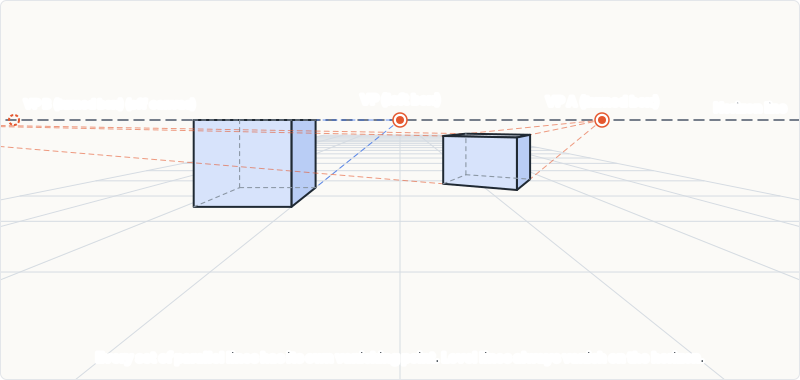
The Krita manual puts it neatly: a vanishing point is where any two parallel lines meet, so one-point and two-point perspective are really the same idea applied to differently turned objects.
Lines that never converge
Edges that run parallel to your paper — such as the horizontal edges of a wall facing you squarely, or vertical edges when you look straight ahead — have no vanishing point in the picture. They stay parallel to the edges of the page. This is what makes one-point and two-point perspective simpler than three-point.
How far apart should vanishing points be?
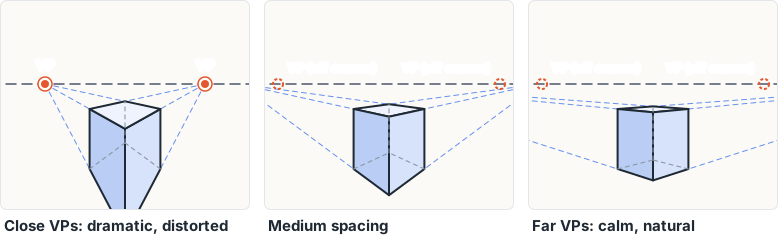
The distance between the two vanishing points of a box is tied to the viewer's field of view. Points close together behave like a very wide-angle lens: corners become sharp and the object looks stretched. Points far apart behave like a normal or long lens and look calm. A common rule of thumb is to keep both points outside the edges of the canvas.
Vanishing points above and below the horizon
Ramps, roofs and stairs slope, so their edges vanish above the horizon (going uphill) or below it (going downhill) — on a vertical line through the vanishing point of their base direction. See inclined planes. When you tilt your view up or down, vertical edges also converge, giving a third vanishing point: three-point perspective.
Moving vanishing points in the grid tool
Drag the round handles on the canvas, or type exact positions in the advanced settings. Positions are not limited to the visible frame, which makes it easy to keep two-point vanishing points comfortably wide.
Frequently asked questions
How many vanishing points can a drawing have?
As many as there are directions of parallel edges. Systems are named by how many are needed for the main box-shaped forms: one, two or three, plus curvilinear systems with four or five.
Why do my boxes look stretched?
Their vanishing points are probably too close together. Move them apart, often beyond the canvas edge.
Can a vanishing point be outside the paper?
Yes, and it often should be. Tape extra paper to the sides, use a long ruler, or use a digital grid that extends beyond the frame.