One-Point Perspective, Step by Step
One-point perspective uses a single vanishing point on the horizon. Faces that look straight at you stay true rectangles; only the edges going away from you converge to the point.
In short
- Use it when a main surface faces you squarely.
- Horizontal and vertical edges stay horizontal and vertical.
- Only depth edges run to the single vanishing point.
- Back edges of a box are parallel to its front edges.
Draw a box in one-point perspective
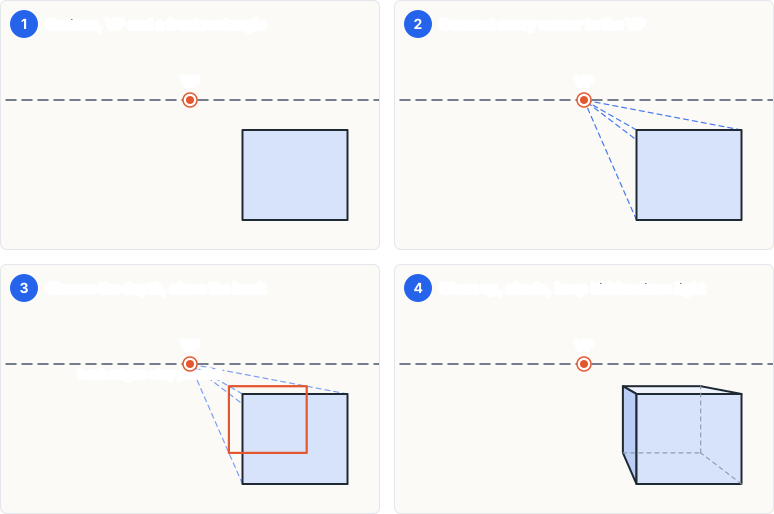
- Draw the horizon and one vanishing point. Place the horizon at the viewer's eye level and mark one vanishing point on it.
- Draw the front face. Draw a plain rectangle anywhere on the page. Its edges are horizontal and vertical.
- Connect the corners to the vanishing point. Draw light lines from each corner of the rectangle to the vanishing point.
- Close the back face. Choose how deep the box is and draw the back edges parallel to the front edges, between the converging lines.
- Clean up. Darken the visible edges, keep hidden edges light, and shade one face to show the form.
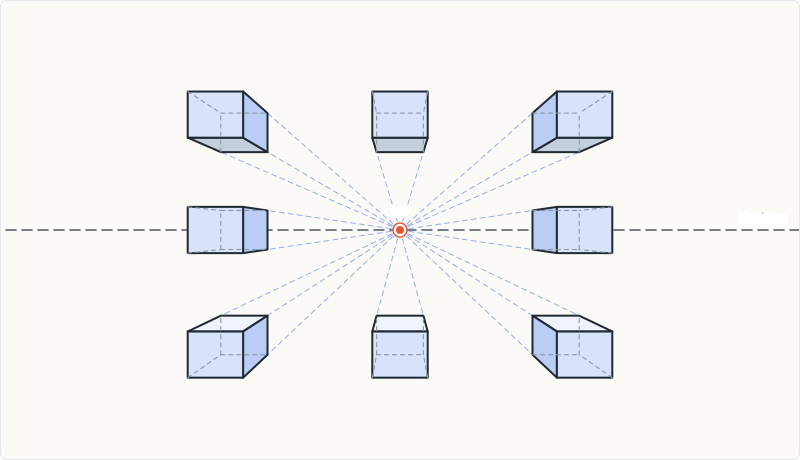
Boxes all around the vanishing point
A classic exercise is to draw a box in each of nine positions around the vanishing point. Above the horizon you see bottoms, below you see tops; to the left you see right-hand sides and to the right you see left-hand sides. A box directly in front of the vanishing point shows only its front face.
How deep should the box be?
In free-hand one-point perspective, the depth is a judgement call: a cube's back face should look a bit smaller than its front, not tiny. If you need accurate depth — tiles, repeating windows — use the diagonal method to step it out.
Where one-point works best
- Rooms seen facing the back wall
- Hallways and corridors
- Roads, railways and avenues
- Symmetrical compositions and title cards
Frequently asked questions
Where should the vanishing point go?
Where the viewer is looking. Centred gives symmetry and calm; off-centre adds interest and shows more of one side wall.
Why are the back edges parallel?
In one-point perspective the front and back faces are both parallel to the picture plane, so their edges never converge.