Roads and Railway Tracks in One-Point Perspective
Rails and road edges are the textbook example of one-point perspective: they are parallel in reality and meet at a single vanishing point on the horizon. The hard part is spacing the ties, poles and dashes — and there is a simple construction for that.
In short
- Rails and road edges run to one vanishing point.
- Ties stay horizontal; their spacing shrinks with distance.
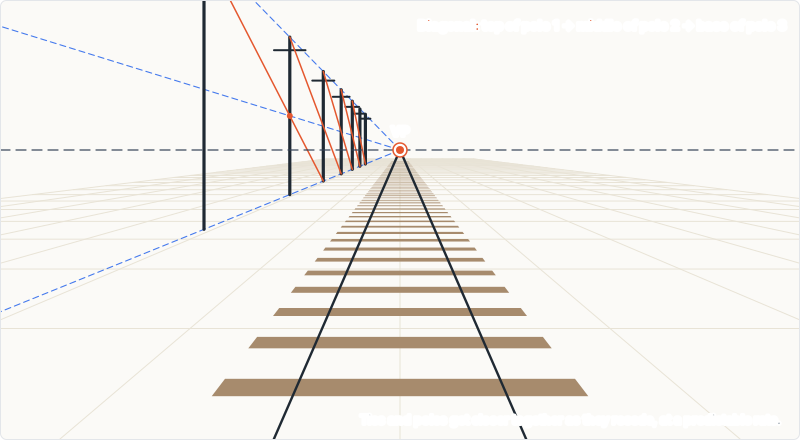
- Find each next pole with a diagonal through the midpoint of the previous one.
Steps
- Set the horizon and vanishing point. The rails will meet at this point.
- Draw the two rails. Two lines from near the bottom of the page to the vanishing point.
- Place the first two ties. Draw them horizontal, with a gap that looks right for the foreground.
- Draw a centre line. Run a line from the middle of the first tie to the vanishing point.
- Find the next tie. Draw a diagonal from one end of the first tie through the centre line on the second tie; where it hits the opposite rail is the third tie. Repeat.
- Add poles the same way. Draw top, middle and base lines to the vanishing point and step out poles with diagonals.
Why the diagonal works
Two equally spaced posts and the ground form a rectangle in the real world. The diagonal of that rectangle, extended, lands exactly one more spacing away. Because straight lines stay straight in linear perspective, the same diagonal drawn on paper lands on the next post — no measuring required.
Roads that turn or climb
A road that bends needs a new vanishing point for each straight section, all on the same horizon. A road that goes uphill vanishes above the horizon; downhill, below it — see inclined planes.
Frequently asked questions
Why do my railroad ties look wrong?
They are probably evenly spaced on paper. Real equal spacing shrinks toward the vanishing point.