Dividing and Multiplying Space in Perspective
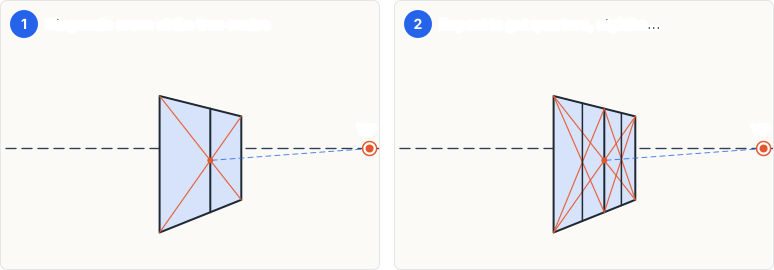
Equal spaces in the real world are unequal on paper once they recede. Two diagonal tricks fix this: crossing diagonals find the true centre of a rectangle, and a diagonal through a midpoint steps out the next equal space.
In short
- Divide: the X of a rectangle's diagonals crosses at its true centre.
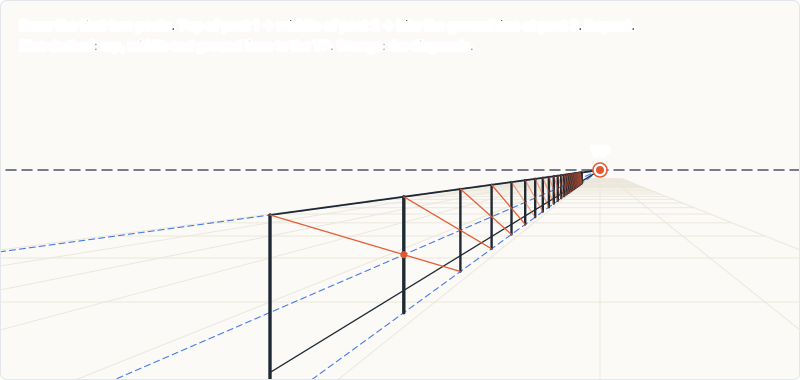
- Multiply: top of post 1 → middle of post 2 → ground gives post 3.
- Both work in any perspective because straight lines stay straight.
Divide a surface in half (and again)
Draw both diagonals of a wall, a door or any rectangle in perspective. They cross at its true centre — which is not halfway across on paper, because the far half is foreshortened. A vertical through that point splits the wall into two equal halves; repeat in each half for quarters, eighths and so on.
Multiply: repeat equal spaces into the distance
- Draw guide lines. Draw the top and bottom of the row of objects to the vanishing point, plus a line exactly halfway between them.
- Draw the first two objects. Place the first two posts by eye; their gap sets the spacing.
- Draw the diagonal. From the top of the first post, draw a straight line through the midpoint of the second post.
- Find the next post. Where the diagonal hits the bottom guide line is the base of the third post.
- Repeat. Continue from the top of post 2 through the middle of post 3, and so on.
Artist Paul Heaston's short video of this trick for railway ties spread widely online — it works for ties, columns, windows, street lamps and floor tiles alike.
Floor tiles
For a tiled floor, draw one row of tiles along the front, then a single long diagonal from a front corner toward the back. Wherever it crosses each depth line marks where the next row of tiles begins. This is the "diagonal measuring line" method used in many drawing courses.
Uneven spacing
For a pattern like door–window–window, mark the real proportions along a horizontal measuring line at the front, run each mark to a vanishing point and transfer them back with a diagonal.
Frequently asked questions
Does the diagonal method work in two-point perspective?
Yes. It works on any flat surface in any linear perspective, because it relies only on straight lines and parallel edges.
Why not just measure?
Equal measurements on paper look wrong in depth. The diagonal gives the correct shrinking spacing automatically.