Inclined Planes: Roofs, Ramps and Stairs
Sloping edges do not vanish on the horizon. They vanish at an auxiliary point directly above the main vanishing point when the slope rises away from you, and directly below it when the slope falls.
In short
- Find the vanishing point of the slope's base direction first.
- Rising slopes vanish above it; falling slopes below it, on the same vertical line.
- Steeper slopes put the auxiliary point farther from the horizon.
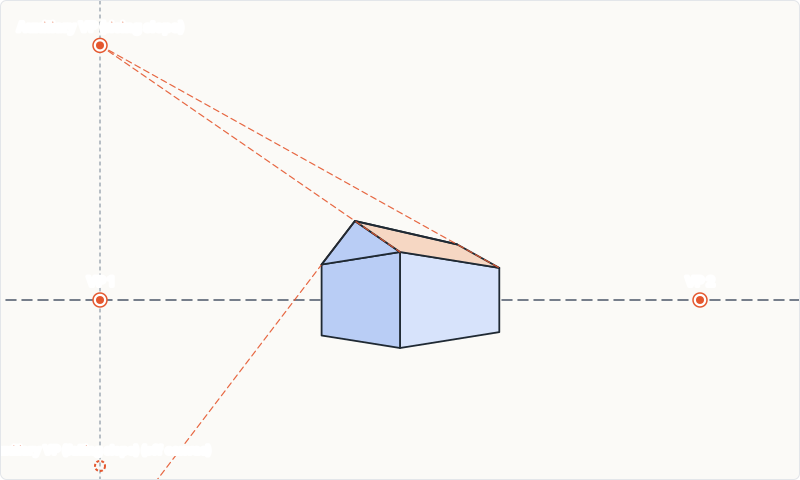
Drawing a gable roof
- Draw the house as a box. Use two-point perspective for the walls.
- Find the ridge height. On the gable end, find the centre with diagonals and raise a vertical to the ridge height.
- Draw the vertical trace. Draw a vertical line through the vanishing point of the gable's base direction.
- Find the auxiliary points. Extend the rising roof edge until it meets that vertical above the horizon; the falling edge meets it below.
- Complete the roof. All other parallel roof edges run to the same auxiliary points; the ridge runs to the other main vanishing point.
Stairs
A staircase is a series of boxes, but its overall slope — the line along the nosings of the steps — vanishes at an auxiliary point above the stair's base vanishing point. Draw that sloped line first, then step the treads and risers between it and the floor.
Hills and streets
A street running uphill vanishes above the horizon; a street running downhill vanishes below it. The horizon itself does not move — it is still the viewer's eye level.
Frequently asked questions
Why are the auxiliary points on a vertical line?
A sloping direction is a level direction tilted up or down. Tilting it moves its vanishing point straight up or down from the level one.