How to Draw a Hallway or Corridor in One-Point Perspective
A hallway is a one-point room stretched out: a small far wall around the vanishing point, four long edges racing toward it, and repeated doors and lights that get closer together as they recede.
In short
- Make the far wall small to suggest length.
- Doors and lights repeat at equal real distances — so they compress on paper.
- Place people with their eyes on the horizon.
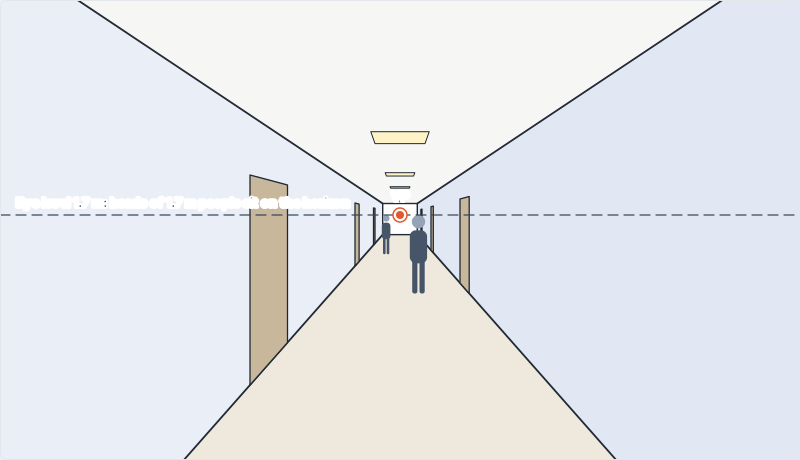
Steps
- Draw the horizon and vanishing point. Put the vanishing point where the corridor ends.
- Draw the far wall. A small rectangle around the vanishing point.
- Run the four long edges. From the corners of the far wall, draw lines through to the edges of the page.
- Place the first door. Draw it on a side wall using lines to the vanishing point for its top and bottom.
- Repeat doors and lights. Use the diagonal method to step out equal spacing in depth.
- Add people. Draw figures with their eyes on the horizon; they get smaller but their eyes stay on the line.
Getting the rhythm of doors right
Doors that are, say, 3.5 m apart in reality appear closer and closer together toward the vanishing point. Rather than guessing, draw the first two door frames and use a diagonal through the midpoint of the second to find the third, then repeat. The technique is shown in dividing and multiplying space.
Mood and composition
- Centring the vanishing point gives a symmetrical, tense look — useful for horror and sci-fi.
- Shifting it sideways feels more natural and shows one wall in more detail.
- A lower horizon makes the ceiling dominate; a higher one shows more floor.
Frequently asked questions
How do I make a hallway look longer?
Shrink the far wall and add more repeating elements; the more they compress, the longer the space reads.