The Horizon Line Is Your Eye Level
In perspective drawing the horizon line is not the place where land meets sky; it is the height of the viewer's eyes. Every level surface in the scene vanishes on it, so placing it is the first decision in any drawing.
In short
- The horizon line always sits at the viewer's eye level.
- Objects above the line show their underside; objects below it show their top.
- A low horizon feels heroic and tall; a high horizon gives an overview.
- Standing adults on flat ground have their eyes on the horizon, at any distance.
Above, on and below the horizon
Hold a box at different heights in front of your face. Above your eyes you see its bottom; at eye level you see neither top nor bottom; below eye level you see its top. The same thing happens in a drawing: the horizon line divides what is seen from below from what is seen from above.
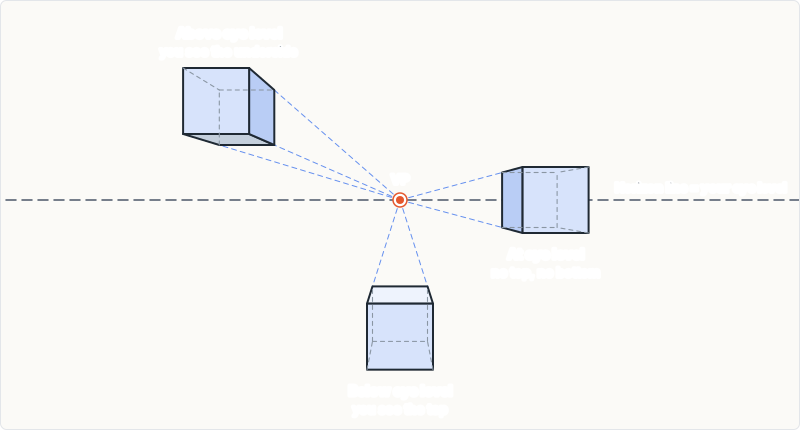
How to choose the horizon height
Decide where the viewer is: lying on the ground, standing, sitting, on a balcony, in a plane. Then place the horizon where that person's eyes would be in the frame. The horizon is not required to be in the middle of the page — it can even sit above or below the frame.
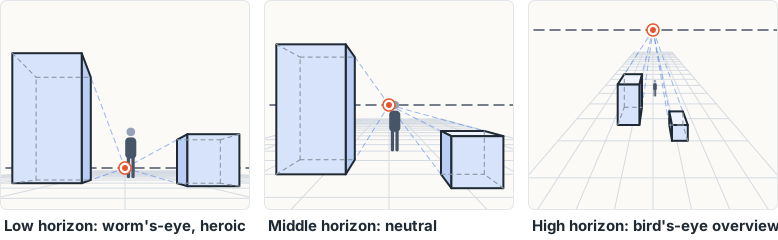
- Low horizon (worm's-eye): buildings and characters loom over the viewer. Good for drama and scale.
- Middle horizon: a neutral, documentary feeling; most everyday scenes.
- High horizon (bird's-eye): you see the ground plane and layout clearly. Good for maps, crowds and establishing shots.
The rule that fixes crowd scenes
If the viewer is standing and the people in the scene are about the same height, all of their heads land on the horizon line regardless of distance. Near people are big, far people are small, but their eyes share the same line. If the viewer sits down, the horizon drops to chest height on everyone — again, for all of them at once. See figures in perspective for the full technique.
Finding the horizon in a photo
Extend two edges that are level and parallel in reality — the top and bottom of a window, for instance — until they meet. Do this for a second set of level edges. The line through the two meeting points is the horizon. The method is covered step by step in how to find vanishing points in a photo.
Set it in the grid tool
In the generator, the Horizon Height control moves the eye level. Try the same scene with a low, middle and high horizon before you commit — it is one of the quickest ways to change the mood of a composition.
Frequently asked questions
Can there be two horizon lines in one drawing?
Not for a single viewer on level ground. Objects turned at different angles get different vanishing points, but all of those points sit on the same horizon.
Does the horizon have to be visible?
No. Indoors, or when looking at a tall building, the true horizon may be hidden or even outside the frame. You still place it to construct the drawing.
Where is the horizon when looking up at a tower?
Below the centre of the picture, often near the bottom or below the frame. Tilting your view up also introduces a third vanishing point for vertical lines.