Two-Point Perspective, Step by Step
Two-point perspective is for looking at a corner. The two sets of horizontal edges each converge to their own vanishing point on the horizon, while vertical edges stay vertical.
In short
- Two vanishing points, both on the horizon line.
- Start from the nearest vertical edge.
- Verticals stay vertical; only horizontals converge.
- Keep the vanishing points wide apart for natural results.
Draw a box in two-point perspective
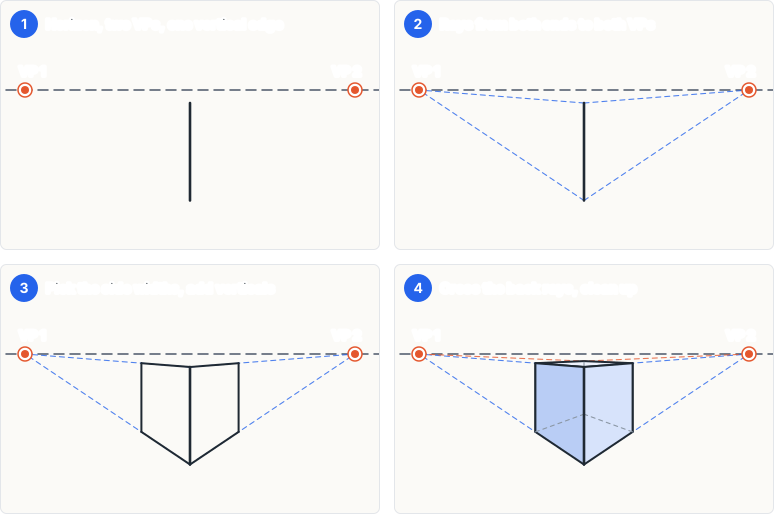
- Draw the horizon and two vanishing points. Place them far apart — near or beyond the page edges.
- Draw the nearest vertical edge. This is the corner of the box closest to the viewer.
- Connect both ends to both vanishing points. Four light lines: top and bottom of the edge to each vanishing point.
- Choose the side widths. Draw two more verticals between the converging lines, one on each side.
- Find the back corner. From the top of each side vertical, draw a line to the opposite vanishing point. Where they cross is the far top corner.
- Clean up and shade. Darken visible edges and shade the two sides differently.
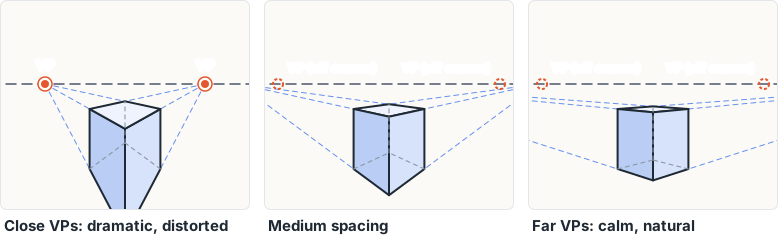
Vanishing point spacing
The closer the two vanishing points are to each other, the more extreme the perspective looks. If the nearest corner of your box looks sharper than a right angle on paper, the points are too close. Most artists place at least one point beyond the edge of the page.
Above and below the horizon
Exactly as in one-point, a box below the horizon shows its top and one above shows its bottom. A tall building that crosses the horizon shows neither, and its horizontal lines tilt down above eye level and up below it.
Typical uses
- Buildings and street corners
- Room interiors seen into a corner
- Furniture, vehicles and product sketches
Frequently asked questions
When should I use two-point instead of one-point?
Whenever you see a corner of the main object rather than a flat face.
Do vertical lines ever converge in two-point?
No. If verticals converge you are in three-point perspective.