What Is Perspective Drawing?
Perspective drawing is a set of rules for drawing three-dimensional space on a flat surface so it looks the way your eye sees it: things get smaller as they move away, and parallel edges appear to meet at points on the horizon.
In short
- Objects look smaller the farther they are from your eye.
- Parallel edges that run away from you converge to a vanishing point.
- All level (horizontal) lines vanish on the horizon line, which is always at your eye level.
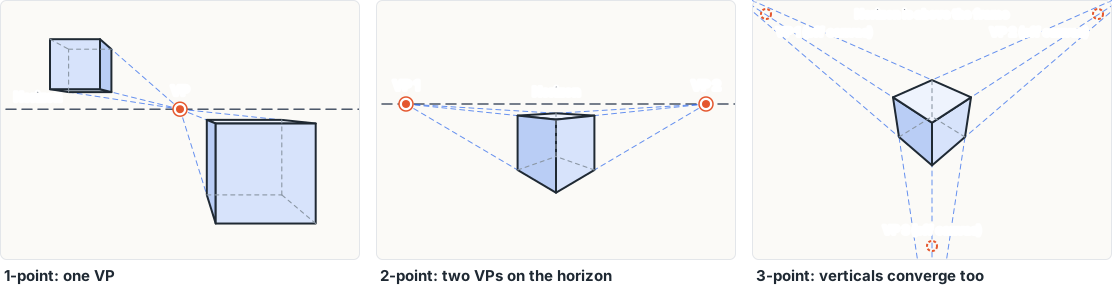
- The number of vanishing points you use (1, 2, 3 or more) describes how the scene is turned toward you.
Think of your paper as a window
Imagine standing still and looking at a street through a pane of glass. If you traced every edge you see onto the glass with a marker, you would have a perfect perspective drawing. That pane is called the picture plane. Your drawing is simply what lands on that imaginary window.
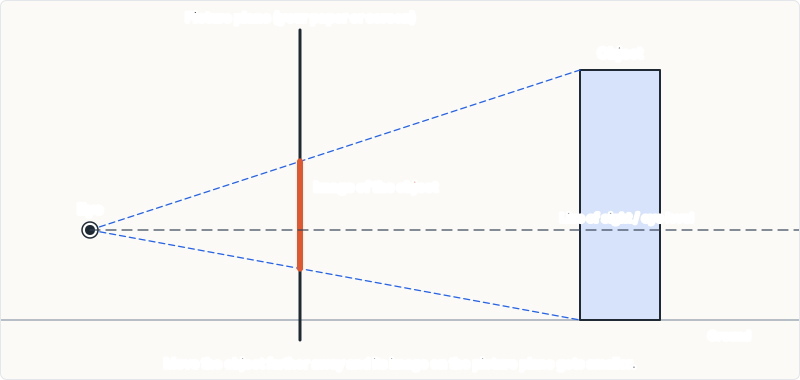
Two things follow directly from this picture. First, an object twice as far away produces an image roughly half as tall. Second, edges that point straight away from you seem to shorten, an effect called foreshortening.
The four words you need
- Horizon line (eye level): a horizontal line across the picture at the height of the viewer's eyes. Every level surface — floors, tabletops, roads — recedes toward it.
- Vanishing point (VP): the point where a set of parallel edges appears to meet. Level edges always vanish somewhere on the horizon line.
- Picture plane: the imaginary window your drawing represents.
- Station point: the position of the viewer's eye. Moving it changes everything else.
One, two or three points?
A cube can be drawn with one, two or three vanishing points depending on how it is turned relative to you. If one face looks straight at you, only the edges going away converge: one-point perspective. Turn the cube so a corner points at you and the two sets of horizontal edges each get their own VP: two-point perspective. Tilt your head up or down and the vertical edges converge too: three-point perspective.
A short history
Painters knew for centuries that distant things look smaller, but a consistent geometric system arrived in Renaissance Florence. Filippo Brunelleschi is generally credited with demonstrations of correct linear perspective around 1415–1420, and Leon Battista Alberti described a method for painters in his treatise De pictura around 1435. Two-point constructions were published by Albrecht Dürer in 1525.
Why artists use a perspective grid
Once you place a horizon and vanishing points, every other edge in the scene must agree with them. A perspective grid lays out those guide lines for you, so you can spend your attention on the drawing instead of on ruler work. You can generate one with the free tool, export it as a transparent image, and draw on a layer above it.
Frequently asked questions
Is perspective drawing hard to learn?
The core idea fits in one sentence: parallel edges meet at vanishing points on the horizon. Most beginners can draw a convincing box in one-point perspective in a single session; scenes take more practice.
Do I need a ruler?
A ruler or a printed grid helps while you learn. Many artists later work freehand and only check key lines against the vanishing points.
What is the difference between linear and atmospheric perspective?
Linear perspective is about geometry: size and convergence. Atmospheric perspective is about air: distant things look lighter, bluer and less detailed. Good scenes use both.