Common Perspective Mistakes and How to Fix Them
Most perspective problems come from a handful of habits: vanishing points placed too close, verticals drawn by eye, depth divided evenly, and figures that ignore the horizon. Each has a simple, mechanical fix.
In short
- Move vanishing points wider, usually off the canvas.
- Keep verticals vertical in one- and two-point perspective.
- Use diagonals to space repeating objects in depth.
- Put standing adults' eyes on the horizon line.
1. Vanishing points too close together
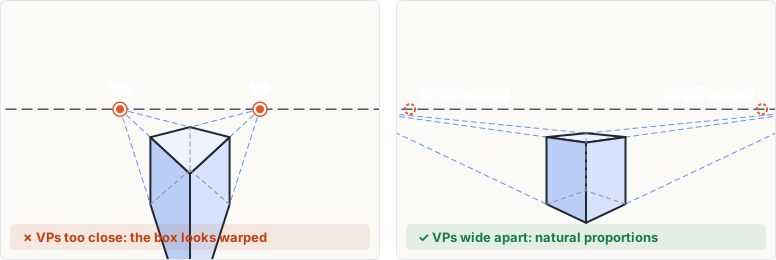
When the two vanishing points of a box sit close to it, the near corner becomes a sharp spike and the object looks distorted, as if seen through a very wide lens. Slide the points apart until the closest corner is no sharper than about 90° on the paper.
2. Leaning verticals
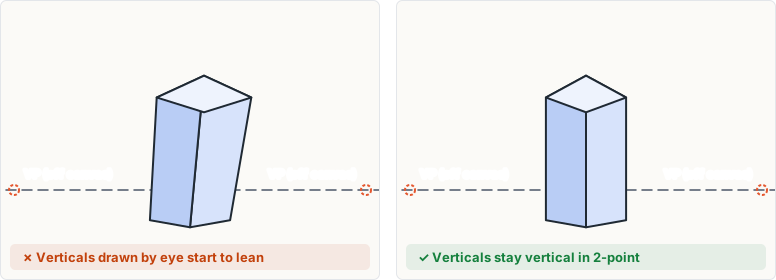
In one- and two-point perspective, vertical edges stay perfectly vertical. Drawn by eye they tend to fan out. Check them against the edge of the page or a vertical guide.
3. Equal spacing in depth
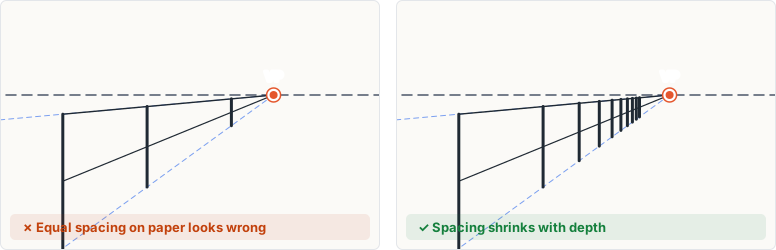
Fence posts, floor tiles and windows that are evenly spaced in reality get closer together as they recede. Measuring equal gaps on paper makes the scene look flat. Use the diagonal method instead.
4. Figures that ignore the horizon
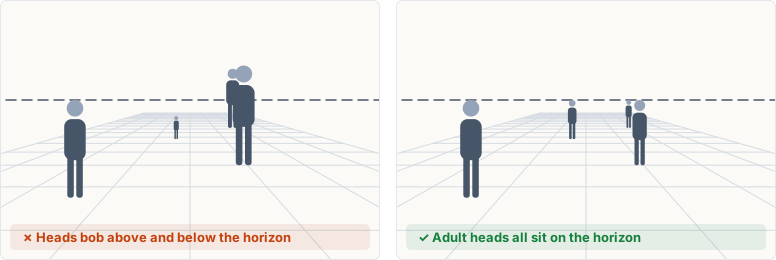
For a standing viewer, adults standing on the same floor all have their eyes on the horizon. Heads that bob above and below it make people look like giants or children. See figures in perspective.
5. More than one horizon
A single viewer has a single eye level. Different objects may need different vanishing points, but all level ones belong on the same line.
6. Football-shaped ellipses
Circles in perspective are ellipses with rounded ends, never pointed. Their openness also changes: the farther from eye level, the rounder. See ellipses in perspective.
7. Mixing systems without meaning to
If some verticals converge and others do not, the scene feels unstable. Decide at the start whether the view is level (verticals parallel) or tilted (verticals converge to a third point), and apply it everywhere.
8. Drawing details before boxes
Windows, doors and furniture are easier when they subdivide a box you have already placed correctly. Block in simple volumes first, then cut them up.
Frequently asked questions
Why does my drawing look flat even with vanishing points?
Usually because spacing in depth is even and detail is equally sharp everywhere. Compress spacing with distance and simplify far objects.
How do I check perspective on a finished drawing?
Extend a few edges with a ruler and see whether they meet the right vanishing points, or lay a perspective grid over the image on a separate layer.