Four-Point Perspective
Four-point perspective is a curvilinear system: straight lines in the world become curves on paper so the picture can show a much wider field of view than linear perspective without stretching the edges.
In short
- Horizontal lines curve between a left and right vanishing point.
- Vertical lines curve between a top and bottom vanishing point.
- It works like a panoramic or wide-angle lens.
- Definitions vary — some teachers place four points along a panoramic horizon instead.
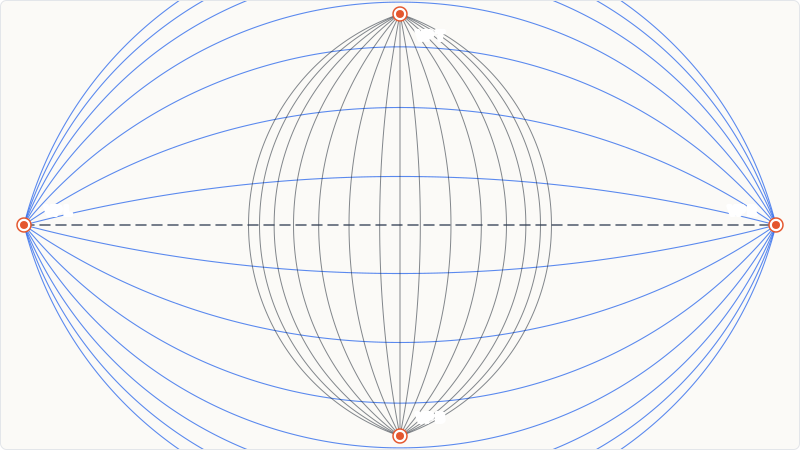
How the grid is built
In the common version shown above, horizontal edges are arcs that pass through a vanishing point at the far left and another at the far right of the horizon. Vertical edges are arcs through a point at the top and one at the bottom. Lines near the centre are almost straight; lines near the edges bend strongly.
Another version — described on Wikipedia — places four or more points evenly along a horizontal horizon to make a panoramic strip. Both share the same idea: in a curvilinear system, a straight edge becomes a curve between two vanishing points, one at each end.
When to use it
- Panoramas that show more than about 90° of a scene.
- Stylised illustrations and comics where curved space adds energy.
- Interiors where you want to show three walls at once without stretching the corners.
Digital help
Krita's Curvilinear Perspective assistant (added in version 5.3) draws arcs that converge at two chosen points and can be combined with other assistants to build four- and five-point setups. A printed or exported grid works just as well for traditional drawing.
Frequently asked questions
Is four-point perspective realistic?
It approximates how wide-angle and panoramic images look, and some argue it matches human vision better at the edges than linear perspective.
Is four-point the same as fisheye?
Close relatives. Five-point fisheye adds a central vanishing point and fits the whole image inside a circle.